Episode Transcript
[00:00:00] Speaker A: Speaking of excavators, like, that's. That's one thing that I think our most tenured operators are very proud to be in.
[00:00:07] Speaker B: That's their workspace, man. They. They know those hydraulics and I mean, there's guys out there open a can, reach out there with that bucket and snap it open. And it's because they get so used to the controls. And frankly, that's what you want. You want to take care of that guy. You. You need a guy because that. That is going to be a safe dude. He knows exactly what goes on with it. Right.
[00:00:24] Speaker A: They make a big impact on the field.
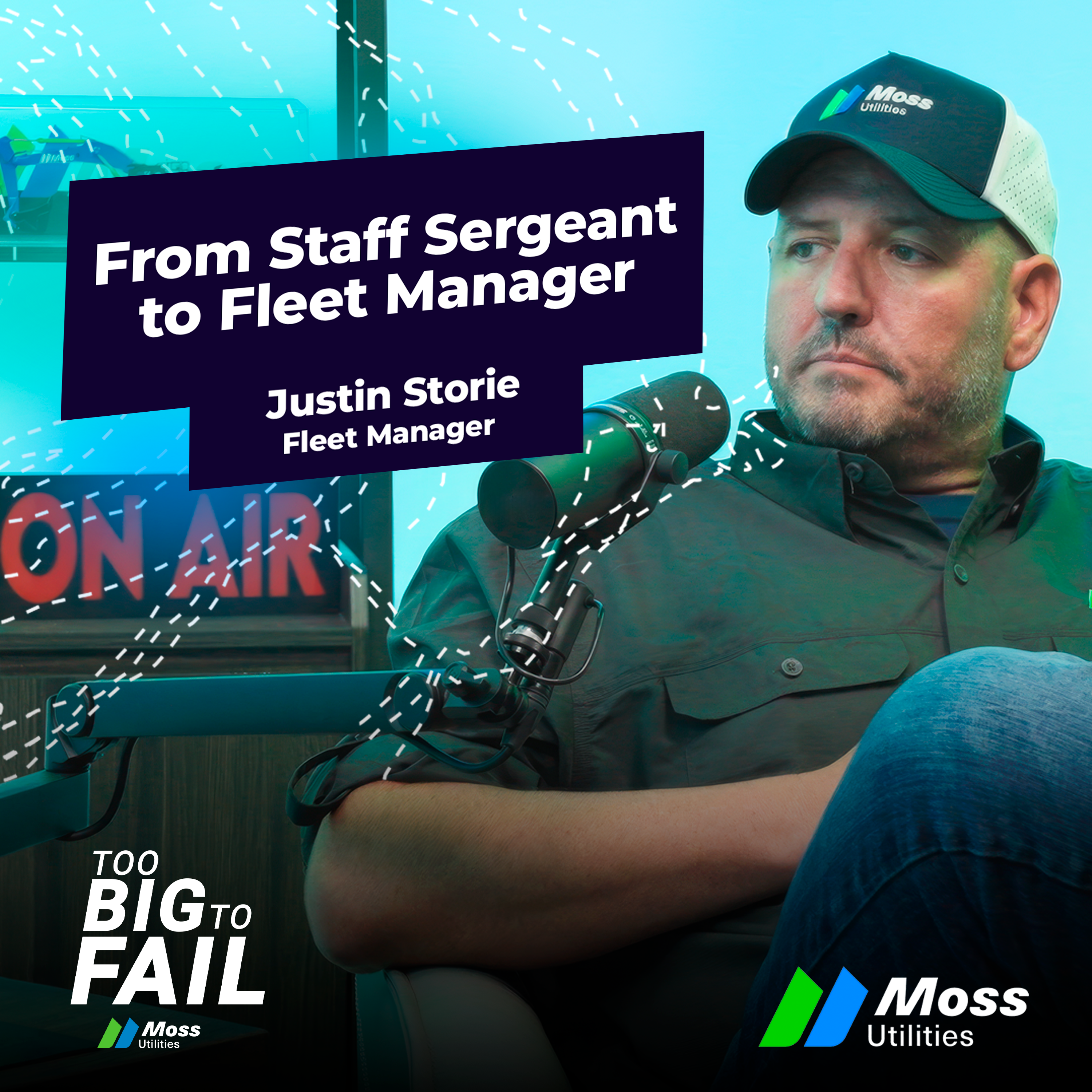
Hey, Justin, welcome to Too Big to Fail. And we'll get started a little bit on your impact here in Moss.
Where did you grow up?
[00:00:44] Speaker B: I grew up in Houston.
[00:00:45] Speaker A: Houston.
[00:00:46] Speaker B: I was born in Lawton, Oklahoma, and then moved to Houston when I was maybe fifth or sixth grade.
[00:00:52] Speaker A: So majority of life has been here in Texas.
[00:00:54] Speaker B: Been in Texas, yeah.
[00:00:55] Speaker A: Yeah. Yeah. You like Texas?
[00:00:56] Speaker B: I do. I like it very much.
[00:00:58] Speaker A: Yeah. You still have family back in Oklahoma?
[00:01:01] Speaker B: I got a uncle left up there, but other than that. Now everybody's better.
[00:01:07] Speaker A: Go on.
[00:01:07] Speaker B: Moved away. Something.
[00:01:09] Speaker A: Yeah. When. What was your first gig in the construction industry or.
[00:01:13] Speaker B: My first gig was. I've only had one gig in the construction industry, and that was right before this one.
[00:01:18] Speaker A: Yeah.
[00:01:18] Speaker B: I worked for a different company that most of what I dealt with was overhead utilities and the fleet side.
[00:01:24] Speaker A: Yeah. When you say fleet side, like, it's like the trucks that they drive or is it the heavy equipment or.
[00:01:30] Speaker B: A little bit of everything.
[00:01:31] Speaker A: A little bit of everything.
[00:01:31] Speaker B: Most over there was bucket trucks and digger trucks, you know. Yeah, digger trucks got a claw on it and a big auger and they. They dig the hole that you see the light poles in. And then the bucket trucks, obviously, you know, they got the bucket and go up and work on the power lines.
[00:01:44] Speaker A: So you've only been in the construction industry for a short period of time?
[00:01:47] Speaker B: Yeah, we're talking nine years now, I guess, because I was there for eight years.
[00:01:51] Speaker A: Eight years. Yeah.
[00:01:52] Speaker B: I worked my way all the way up. I started out as a dispatch assistant, and then they needed somebody to run a yard in Beaumont. And I actually think I was like the third choice.
But then when nobody else wanted to drive from Houston to Beaumont every day, I already lived in Baytown, was like, oh, well, that's not that bad. You know, 45 minutes drive. 45 minutes to this gig, you know. So I was like, all right, I'll do that. So I took over a Yard got my first yard and then I was there for maybe a year, year and a half and two, two yards opened up where they needed a manager, you know, to be over the two yards.
So guy before me just drug up randomly and they said, well, you want it? And I said, heck yeah, I want it.
[00:02:36] Speaker A: So, well, what was your first impression on like working for a construction company? Was it like kind of what you anticipated?
[00:02:43] Speaker B: Yeah. You know, being a veteran, what I find is like the operation guys very similar, you know, like guys are serious about what they do and good at what they do, but there's a certain, I don't know what this come across the wrong way, but like goofy childness to the way they conduct themselves. However they, they execute, you know, they have a good time while they're, while they're working hard. And I think that's a, that's a place where the military and the construction industry cross.
[00:03:10] Speaker A: Yeah, well, how old were you when you first got into the military?
[00:03:15] Speaker B: You know what, for a guy at boot camp, I was old.
I think I was 22.
[00:03:18] Speaker A: 22.
[00:03:19] Speaker B: But boy, I tell you what, I felt old. I remember we were taking a flight from Fort Benning, Georgia.
They put us on a civilian flight. We were all reporting to Fort Drum, New York. So we're flying to New York and I'm sitting there and all these other privates that are like 18, 19 years old are sitting around me. And one of them goes, hey man, you know, you ever been up to New York? I was like, I mean, the States up there are real small, so we must not be that far from the city.
[00:03:44] Speaker A: You know, I would have been like, does it sound like I've been to.
[00:03:48] Speaker B: But oh yeah, I'd have had a good take. I sound like I've been in New York, boy.
But you know, I mean, I was the old wise one at 22 years old or whatever it was. So I was like, oh yeah, man, states up there are real small. It can't be that far from New York City. It was seven hour drive. Yeah, yeah, we were pretty good ways.
[00:04:07] Speaker A: Um, so you, you got into the military? What branch did you start off?
[00:04:10] Speaker B: I was in the army.
[00:04:11] Speaker A: In the army?
[00:04:11] Speaker B: Yeah.
[00:04:12] Speaker A: You the entire time?
[00:04:14] Speaker B: Oh, yeah. My, my, my biological father was in the army. My little brother's still in the army.
[00:04:19] Speaker A: Okay.
[00:04:20] Speaker B: I think he retires in about a year. Yeah, all, almost all of my family's been army, so it was never, it was a no brainer. You meet guys that are like that, they're just generational, I think we had a grandpa that was in the Navy in World War II.
[00:04:33] Speaker A: Oh, wow.
[00:04:33] Speaker B: Yeah.
[00:04:35] Speaker A: So you were in the. In the army for how long?
[00:04:38] Speaker B: 12 years.
[00:04:39] Speaker A: 12 years, yeah.
[00:04:40] Speaker B: Just short of 12 years, I think.
[00:04:41] Speaker A: Yeah. Wow. That's a. That's a long time. That's a life. That's a whole lifestyle there.
[00:04:44] Speaker B: Yeah.
[00:04:45] Speaker A: What was your transition from going to the army to, like, coming back home? Like, where'd you start off working or how? You know, I worked for a freight
[00:04:53] Speaker B: company, was a union company, which was a hard transition from being military and coming out as a staff sergeant and going straight into, like, being in a union environment where everybody's resistant to anything management says, you know. So, yeah, so I worked in. I worked there for a few years and then went on to another dispatching gig, went to school at Sam Houston and, you know, just. Just wasn't real happy in any of those jobs in the trucking industry. And so, you know, I kind of moved around and looked for something that. That I was excited to do. And. And, you know, once I. Once I got started in the construction industry, I kind of knew that's where you wanted to. That's my niche. Yeah. That's what I want to do.
[00:05:34] Speaker A: I feel like that that tends to be a very, very common theme of. Of the construction industry is kind of not what people expect it to be. Right. Because it's just.
I mean, I think I've said this over and over again, but it's. It's kind of has its.
It's portrayed a certain way being in the construction industry. Right.
You talk to, you know, this office employee, right, at this corporation, and they talk about construction and all they think about is dirt and a shovel. Right. They don't understand all the important aspects that come into play when it, you know, deals with the construction company, like Fleet. Right.
But, yeah, I think people gravitate a lot more towards the construction industry nowadays.
[00:06:21] Speaker B: It's tangible. You build it, you can see it. You know, like, when I worked freight, I remember one of the things I'd be the unhappiest about was I was a supervisor on the dock, you know, doing what's referred to as inbound operations. And the freight comes in you, all the stuff comes off the trailers and goes onto the trailers that's going to go out for delivery as. Right? Well, you have the best day ever. I mean, you just killing it, right? Moving four or five bills an hour, loading the trucks. Trucks are loaded perfectly. Everybody goes out and does deliveries.
You come in the next night, there's same Number of trucks around the same amount of work to be done. The same.
[00:06:58] Speaker A: Extremely repetitive.
[00:06:59] Speaker B: Yeah, it's just extremely repetitive. And so in construction, yes, it's competitive, it's repetitive. But you go down the road and you see something and you're like, hey, man, we built that. You know, like Moss built that. That's, that's ours. We got, now we're building another one down the street, you know, so we're busy. Right. It's not like it's, it just stops. But, you know, we're, we're where you build something that you can see and touch and so many things. You don't do that, you know.
[00:07:26] Speaker A: Yeah. How, how would you compare the culture?
Let's say, you know, you at the first construction company you started to where the freight company.
[00:07:34] Speaker B: You were at first over the freight company to there. Yeah, I don't think that there's really much of a comparison because of the type of work. Like, it just, you know, I couldn't compare one to the other. It's complete apples and oranges.
[00:07:47] Speaker A: Yeah. What about from there to hear?
[00:07:50] Speaker B: I gotta tell you that I didn't know places like this exist. I'm not just saying this, like in this forum, you know, you know, you hear rumors or whatever, but I never saw a guy that was there that was like, oh, no, I was there, you know. Yeah, yeah, no, my day started this morning at, you know, six in the morning. I hit five golf balls with all of my irons on the simulator, lifted a little bit of weight and then went next door and started my day. I, I, you know, you never met a guy that could say, yeah, that's exactly how my day started. Now I am that guy. And by the way, I tell everyone, right?
Like, guys I know from different things when they talk to me, they ask me, probably get sick of hearing about it.
[00:08:29] Speaker A: Yeah.
[00:08:29] Speaker B: Like, that's, I just, it's so cool here, the way that the people are. I was actually just telling John when walking in here, I, I can't remember the last time that I had a job or I was in a place where there's not a single person that works here that I see coming down the hall and I' like, oh, let me duck into this office real quick.
[00:08:49] Speaker A: Yeah.
[00:08:50] Speaker B: You know, like, I genuinely seem to like everybody here.
[00:08:53] Speaker A: Yeah.
[00:08:54] Speaker B: I mean, that's not, that's not my nature. You know, you may not know whether or not I like you, but it's not my nature to just actually like everybody.
[00:09:03] Speaker A: Yeah, I mean, that's, that's hard to Find at companies in general. Right. Whether it's construction or not, to not like hide and duck from people. Right? Yeah, of course you're always going to want to hide and duck when it comes to like paying stuff. Right? Naturally. Right. So you might hide from Ms. Michelle every now and then.
[00:09:21] Speaker B: Oh no, I don't hide from her. You know, I spent that money and I'm proud of it. Let's get them paid.
[00:09:28] Speaker A: Hey, I just bought this excavator. Yep.
[00:09:30] Speaker B: Well, that, that call comes a little higher than me. You know, on ours is for fleet decisions, it really comes down to like understanding utilization. Right. Understanding how much life this unit's got left in it.
[00:09:49] Speaker A: Yeah.
[00:09:49] Speaker B: Right. And, and making a decision based on those things. If is this worth, is this repair worth it? Is this money that we're spending worth it? And you know, there's organizations that help you learn that stuff and then you learn it by experience. Right. It's.
It's a niche. Right. And it's hard because sometimes fleet guys try to explain what they do and it is hard to explain.
[00:10:12] Speaker A: Yeah. Well, let's dive in a little bit more into that. So fleet operations, how. How does that impact the field?
[00:10:19] Speaker B: Well, when machines are down, like the jobs down, you know, like if, especially if it's a critical machine, I mean that may not be the case every time, but a critical machine, a big excavators down or a wheel loader or something like that, they're just, you know, they can't, can't work. I guess they could get out shovels.
[00:10:34] Speaker A: Yeah.
[00:10:35] Speaker B: You know, start digging a hole with shovels. But that's, that's not a good idea. You know, it's going to take a little, little while and that's going to be way more, you know, way less cost effective.
[00:10:43] Speaker A: Right.
[00:10:44] Speaker B: Hours go through the roof to do something like that. So it comes down to that. And, and then being able, you would appreciate to do jobs safe.
You know, a bunch of guys in a, in a ditch with shovels is not as safe as a guy above the ditch with a excavator digging it out. Right.
[00:11:01] Speaker A: Absolutely.
[00:11:02] Speaker B: Yeah. So it's, it's imperative that they have good, solid, well maintained, safe equipment to operate.
[00:11:10] Speaker A: Yeah. So do you also oversee a little bit of the, I guess you, you would say like the PM on the, all the equipments and.
[00:11:19] Speaker B: Yeah, the preventative maintenance. Yeah.
You know, we have a specific kind of team that does that. You know, we got some lube fuel, lube trucks out running around fueling stuff, doing PMS on them.
Keeping up with the schedules. We use some third parties for it. And then Mike in there, he kind of coordinates all of it. Make sure that we have the right parts. Right guy. Right.
Right area, you know, and get, get as much done as we can there. And then obviously I think I can say a company by name where we're switching over to the fleet management software clue, which I say we're switching over. It's, it's active, it's hot right now.
[00:11:53] Speaker A: Yeah.
[00:11:53] Speaker B: That's going to make this easier to manage, I think. You know, the hours and the predictability of it. Right. Seeing, seeing all of that in one place instead of having to go to
[00:12:03] Speaker A: three or four different places to find.
[00:12:05] Speaker B: Find the information. Yeah.
[00:12:07] Speaker A: So, so there's, there's the fleet, I think oversees a bunch of things. Right. Because it also oversees like, like getting the equipment to the field. Right. So, so how does that look like as well?
[00:12:20] Speaker B: So a lot of it goes by the crews here. You know, like this crew is going to that job and they've had this excavator and this wheel loader and this. So we'll just move a whole crew from job to job. Right. If everything's in good working condition, this, this new software we're just talking about has a function where guys can go in and make requests. Right. Hey man, we need another, you know, 350 out here and they can go in there and select that.
And it sends a push notification to myself and Matthew, who, you know, we're gonna find a machine and dispatch a driver and snatch it up, move it over wherever it needs to go.
[00:13:02] Speaker A: Yeah, yeah. Because I mean, what would you say a typical fleet on a job site would be like equipment and all.
What would that consist of?
[00:13:12] Speaker B: Think for a crew, you know, it kind of depends on the job side. Right. So for a crew, I believe we've got two excavators, a wheel loader and one pickup. You know, they got a foreman truck, water truck. Oh, and a water truck. Yeah, there's water trucks out there.
[00:13:30] Speaker A: Roller.
[00:13:31] Speaker B: Roller. Well, it depends on the job. Not every, not every crew's got a roller.
[00:13:34] Speaker A: Oh, because they also use those compaction wheels. Yeah, yeah, yeah. I think that's, that's one of the things that the field can appreciate. Right. And you know, get having good equipment out there. Right. Because imagine having dinosaurs out there trying to, you know, push production and quality all at the same time. It's like it's not going to be the same. Right. So having a good fleet department to, to be able to keep up with the crews. Right. And having good equipment is, is going to be crucial.
[00:14:07] Speaker B: Oh, yeah, Yeah. I, I think the.
We buy good units, you know, we got good units out there in the field and I think we get rid of machines in a pretty timely manner, you know, get them off to auction or, or, or remarket them ourselves. But yeah, they, they've.
I think we have pretty good machines.
[00:14:26] Speaker A: Yeah.
[00:14:26] Speaker B: Oh, and I. Yeah, one of the other things is a machine may not be broke down, but you know, once it gets to a certain amount of hours, the operating cost goes through the roof.
[00:14:35] Speaker A: Yeah.
[00:14:35] Speaker B: And that's, that's one of the things you're trying to avoid. And it's because of breakdowns, it's because of PMs, it's because even fuel consumption, you know, it just starts getting really expensive to keep out there.
[00:14:48] Speaker A: Yeah. If you could send a message to, to a wheel load operator, excavator operator, and a foreman like, you know, to, to explain to them your support to them, what would you tell them?
[00:15:01] Speaker B: If I were going to give them advice, I would say do an inspection every day, inspect your equipment every single morning. Right. And maybe inspect it in the evening. Doesn't need to be as thorough as the morning. Right. But, but check it over in the evening because if you got some hydraulic leak that's starting to seep or something like that, it's a lot easier to get that thing fixed in a timely manner than when that hose blows. Right. Yeah, that's a lot easier to describe. Our support fleet can be a very invisible aspect of the industry. Right. And if you're operating well, it should be right. Nobody really thinks about it.
They're just out there working.
Nobody thinks about it. My name doesn't cross their mind all day. And man, I hope we get there right.
I mean, that means there ain't no work orders open. All the units are out there running just fine. You know, they were filled up before you got to work in the morning and you know, have a good day.
[00:15:53] Speaker A: That just means you're taking care of
[00:15:54] Speaker B: business and that just means it's done right. It's not, you know, it's kind of a offensive lineman almost of, you know, the, of the industry. It's not real sexy, but it's getting knocked out.
[00:16:05] Speaker A: Yeah. And I think that's one of the biggest things that we want to like, push out on this podcast. Right. Is explain to the guys out in the field that like, everything that we do at the end of the day comes down to them. Yeah. It comes down to Them. Right. And they don't realize how important they are. Like they are the backbone. Like we can bid all the work in the world. Yeah, right. But if we don't have a crew to do it.
[00:16:27] Speaker B: Yeah, absolutely.
[00:16:28] Speaker A: Then we're pointless.
[00:16:29] Speaker B: Yeah, right, yeah. You got to have somebody out there doing.
[00:16:32] Speaker A: I have someone to do it. Right. And you know, if there's no crews out there, I have no work. Right. I'm pointless, you know.
[00:16:40] Speaker B: Yeah.
[00:16:40] Speaker A: Nothing to do here.
So they give value to the company by executing their work, you know, safely with quality and production.
[00:16:51] Speaker B: Absolutely, yeah.
[00:16:53] Speaker A: And that goes, you know, that goes with every department. Right. Because I think that's essentially what you want as well with your fleet team. Right. You want them to obviously, in their sense. Right. Have a form of production, good quality and work safely.
[00:17:08] Speaker B: Yes.
[00:17:08] Speaker A: Right.
How many luft truck drivers do we have right now?
[00:17:13] Speaker B: Well, that's a tricky question because there's actually four, but one of them is kind of a small. Well, I think we actually just pulled the tanks out of that one. So three out there running around right now.
[00:17:26] Speaker A: Three lube trucks basically.
Servicing how many pieces of equipment roughly?
[00:17:33] Speaker B: Well, I know there's a. As of yesterday, there was like 119 full size excavators.
I want to say it was 1012, something like that. Many, many excavators. Right. There's a ton of wheel loaders out there.
Maybe 50, 40, 50, something like that.
[00:17:52] Speaker A: Wow.
[00:17:53] Speaker B: Oh, the fleet overall, everything that has a unit number saved in the system. As of yesterday, the fleet was 712 pieces.
[00:18:01] Speaker A: And that's. Including, I mean, that's, that's.
[00:18:04] Speaker B: There's some buckets in there, stuff like that that have unit numbers.
[00:18:08] Speaker A: I mean, so you can't do nothing without a bucket. So.
[00:18:10] Speaker B: Yeah, yeah. So yeah, no, the best excavator in the world's no good without a bucket.
[00:18:14] Speaker A: Yeah.
[00:18:14] Speaker B: But yeah, there's some buckets and different things like that that are mixed into that number, but.
[00:18:19] Speaker A: Cool, cool, cool.
So how long have you been here at MOSS now?
[00:18:24] Speaker B: I think my first day was February 2nd.
[00:18:26] Speaker A: February 2nd. A couple months now.
[00:18:28] Speaker B: Yeah, a few months.
[00:18:29] Speaker A: A couple months now. Best decision you ever made?
[00:18:31] Speaker B: Oh, yeah, I'm very happy.
[00:18:33] Speaker A: Yeah. I think the team overall is very happy to have you here. I think you've seen a big difference in.
And you know how people approach fleet. Right. Because you can see your intentions with making sure that the guys out in the field have what they need. Right. Because I think I said it on a meeting the other day. Well, it wasn't that it was, you know, a while back where they're struggling to get a light tower or something, and you're like, why didn't I know about this? Like, I need to make sure that I have someone ready to get the lights out there.
[00:19:06] Speaker B: Well, you know, it was. It was an emergency job, which you were talking about, and they came up here to get a light tower and they didn't know which one to take. Right.
[00:19:12] Speaker A: And.
[00:19:12] Speaker B: And so I can appreciate that they were just trying to execute, but that, that conversation led to some changes in our standard operating procedure where things are going in a certain area if they're ready to go. But yeah, I was frustrated with that situation, and I think we've. We've come now where it's. I don't think we'll have that problem.
[00:19:32] Speaker A: You have a good process in place?
[00:19:33] Speaker B: Yeah, we got. Well, we have a process in place. It's got to be tested. Never know if it's a good process until it gets tested. So the next time we get an emergency job, you know, and.
Well, we'll know. We'll know in our meeting with. With Julio that we have every week, you know, hey, that didn't work. Or that did. And, you know, if we got to adjust fire, we will.
[00:19:50] Speaker A: Yeah. We do have some night jobs, though. Do they. Are they not requiring those light towers from us?
[00:19:55] Speaker B: Yeah, there's some light towers out at work right now. So this was a kind of a
[00:19:59] Speaker A: one off, you know, because those are obviously planned, right? Yeah, yeah, we know that. Yeah.
[00:20:03] Speaker B: Good. Yeah, they got. That's part of the order and, and part of what's cool about Clue, Right. If you got a job and your crew doesn't have. Normally have light towers, you can get in there and select a light tower, man, you can. You can jump in there and say, oh, this job, I'm going to need a light tower. Now we're. We know to. To get you a light tower.
[00:20:18] Speaker A: Yeah. How. How involved are you with, like, you mentioned Julio right now. Like, how involved are you with him and his like or that department? Right, because it's like Julio, Jose, Christian, like, is it.
[00:20:30] Speaker B: Yeah, it's all gonna go. It all goes through me to funnel to whichever department of the fleet needs to handle it. Yeah.
[00:20:37] Speaker A: Cool. Cool.
[00:20:37] Speaker B: Whether it's Julio or Parker or Christian, I hear from all of them often.
Well, I hear from Parker a lot more, but obviously that's my boss. But as far as the.
The other guys, that mean I hear from them daily, you know, not two or three times a day.
[00:20:53] Speaker A: How's been your interaction. How's your interaction been with them? Good?
[00:20:55] Speaker B: Oh, yeah, absolutely positive, man. I like those guys. Yeah.
[00:20:58] Speaker A: Yeah, they're really good guys. Really guys.
[00:21:00] Speaker B: Yeah, I definitely, you know, I'll hang out with them.
[00:21:04] Speaker A: We really wanted to go to your wedding, but
[00:21:08] Speaker B: I mean, guest list was set before he made the move over here, brother.
[00:21:12] Speaker A: We'll go with that. We'll go with that. Yeah, yeah, yeah. We would have brought a whole band with us.
[00:21:18] Speaker B: Oh, my goodness. That.
You know, what a good time. That sounds like a good time.
[00:21:23] Speaker A: Yeah. I think that's one of the biggest things here is, like, you build relationships with these guys that it's like, to your point, we've become buddies. Right. Like, I don't like personally. I don't really have friends like, outside of work. I have my family and.
[00:21:38] Speaker B: Are you asking me to be your friend? I'll be your friend.
[00:21:41] Speaker A: I can't go.
[00:21:42] Speaker B: Is that what this is? You can't golf, but you could drive a cart. Right. And you're a safety man, so you can drive a cart safely. Right.
[00:21:48] Speaker A: But oh, yeah, to the point is just, you know, working here is great. I mean, that's. Long story short, working here is great. But nonetheless, I appreciate you coming on today and giving us a little bit more insight of what your experience has been here at Moss. And, you know, you're right so far.
[00:22:03] Speaker B: Yeah, I'm glad to be here.
I've enjoyed pretty much everything that I've encountered here. You know, I mean, we got some work to do, but I. I think that, you know, in the next year that I think that we could easily have the premier, premier fleet in dfw.
[00:22:23] Speaker A: Yeah.
[00:22:23] Speaker B: Right. I mean, between the paint schemes, which sounds silly, right. But boy, you see one of them things out there on a job site, sit on the side of the road, looks good. Even the ones that just got the stick painted.
[00:22:33] Speaker A: But speaking of excavators, like, that's. That's one thing that I think our most tenured operators are very proud to be in those sucker. They keep those suckers clean.
[00:22:45] Speaker B: Oh, yeah. No, that's. That's their workspace, man. They get very proud of it. They get very.
[00:22:49] Speaker A: They.
[00:22:50] Speaker B: They have.
They have extreme preferences.
[00:22:55] Speaker A: Oh, yeah.
[00:22:56] Speaker B: You know, when it comes to them. But. And it may sound silly if you don't operate. I've never been an equipment operator. Right. But I've run enough excavators on off trailers or.
[00:23:04] Speaker A: Yeah.
[00:23:04] Speaker B: You know, done whatever kind of needed to be done.
And there's like different play in the hydraulics might sound silly, right? But it's almost like breaking your pickup truck. Like your pickup truck when you drive down the street, you know, when you got to hit the brake pedal, you know when you hit the accelerator, what's going to be over time you get, you build into it. It's the same thing with the excavator, right. They know those hydraulics they can, you know, and I mean there's guys out there open a beer can with one, right. Just reach out there with that bucket and snap it open and then, you know, and it's because they get so used to the controls and, and frankly that's what you want. You want to take that guy. You need a guy because that, that is going to be a safe dude. He knows exactly what goes on with it. Right. He knows when there's a problem. Oh, I didn't like that sound. Right. Yeah. So. And hopefully, right, he's jumping on his app, he's going into Clue and he's reporting that to me. I don't know what that weird sound was even if it just went away. Right. Jump in there, put it in there and let me, let me get somebody out there, take a look at it. Let's see if we can mimic the issue and get it repaired before, you know, that sound turns constant and you can't run the machine and every dashboard emoji it's got on there, you know.
[00:24:16] Speaker A: Yeah. At the end of the day, those are the type of guys that we want and need. Right. Of course not all of them are going to be like that, right. Operators.
But there's a handful of them. Right. And you'll see it this year during Christmas. Right. When we, we pick our, our operators of the year and because they make a big impact out on the field. Right?
[00:24:36] Speaker B: Yeah.
[00:24:36] Speaker A: Like you'll know where to send them. Right. Like I feel like, you know, Julio and his team and, and Christian and his team and Jose, they make decisions also based on the operator. Like, hey, this guy can dig 20 plus feet.
[00:24:51] Speaker B: Yeah, right? Oh yeah.
[00:24:52] Speaker A: Or this guy can dig and rock.
[00:24:54] Speaker B: Yeah, right.
[00:24:54] Speaker A: Cuz you don't want a guy that doesn't know how to dig and rock cuz he's just going to tear up those teeth and you know, it's going to get. You don't say crazy expensive.
[00:25:03] Speaker B: It sure does.
[00:25:03] Speaker A: It gets crazy expensive.
[00:25:05] Speaker B: Yeah.
[00:25:05] Speaker A: So I mean, you know, to the point of like we want good operators, we want guys who care and, and you know, take care of their equipment. At the end of the day, even, even the wheel loaders, you know, even the wheel loaders, those are some big.
[00:25:17] Speaker B: I got to tell you, we have more problems with wheel loaders than we do anything else. Yeah, yeah, those. Because, you know, they get. They just get kind of ragged out, guys, you know, not. Not operators necessarily running them wrong or something. Just they're constantly moving, loading this, loading that, pushing dirt, doing, you know, I mean, they're. They get.
They get tore up.
[00:25:39] Speaker A: Yeah.
[00:25:39] Speaker B: Pretty good. So we.
Some cost associated with that, and we. We spent a lot of time repairing and working on, you know.
[00:25:45] Speaker A: Cool, cool. Well, hey, appreciate you coming on today, man. All right.
[00:25:49] Speaker B: So this. This was a podcast.
[00:25:51] Speaker A: Yeah.
[00:25:51] Speaker B: All right.
[00:25:52] Speaker A: It's great. You're lovely.